Sell More with Less Effort and Greater Value for Your Customers

18.7.2024

14 min
reading time

18.7.2024
14 min
reading time
At BizMachine, we offer you a straightforward way to have all the information you need to create a great offer and lead meaningful conversations with your customers. Everything is available in one place, just one or two clicks away!
The automotive segment is built on long-term relationships. Once you acquire clients, you nurture them. And as long as they're satisfied with your prices and services, they stay. Perhaps that's why, until about four years ago, there were virtually no sales positions at dealerships whose primary concern was acquiring new clients. But that's gradually changing. Data will come in handy for identifying potential customers — not just when you're opening a new showroom or starting to offer a new vehicle model. The usefulness of data is key to successful new business.
Let's look at an example:
You sell premium vehicles and want to know what brands company executives in your region drive. How often do they buy new cars, and do they stay loyal to one brand or switch each time? Would you also need to know whether a given company owner might be open to purchasing an electric vehicle? We can check whether they already have other EVs in their corporate fleet. All this information helps you tailor an offer specifically for a particular executive at a particular company. We probably don't need to point out that the more personalized the offer, the more likely they are to remember it.
Or let's use another example:
When you open a new showroom, what service attracts potential clients best? Yes, you start with a service offer. If a corporate client is satisfied with your services, they'll very likely buy new vehicles from you in the future. But when you open a service center for a brand, hoping customers will just show up on their own is a bit naive — or rather, a process that takes years. At the beginning, you need to be proactive: reach out to potential customers. And when you select only those who actually need your service, your efforts will succeed with less strain.
You know exactly which customers in the region are worth reaching out to — those with appropriately aged vehicles for whom an authorized service center makes sense. Now imagine getting a list of all companies and sole proprietors in the area that operate vehicles of exactly the right age for the brand you service. Including exact counts and specific models. Then you just need to reach out with an attractive introductory service price and convince them through your own work to stay!
“Through our online tool Prospector, you can easily map out all companies currently operating vehicles of the brand you offer. You’ll know not just the age of individual vehicles, but also their models, so you can invite only those most likely motivated to visit your service center. We have excellent experience with how this data works. Most recently, I recall a new Citroën dealer in Pilsen who, thanks to our data and a single targeted ad campaign, filled the capacity of their entire new service center,” adds Martin Střecha, a sales consultant specializing in the automotive segment at BizMachine.
You’ll be far more effective in sales when you offer exactly what companies need, and precisely when they need it. Segmentation helps with that. You probably already do it in some form with your existing customers, but did you know you can also segment potential ones? Let’s look at a few practical examples of how segmentation works in practice.
“As a salesperson, this gives you an advantage — you reached out in time, showed them where they might have a problem, and solved it for them right away. Your offer becomes not only relevant but genuinely useful at that moment. It also creates the foundation for a long-term relationship. The customer remembers: ‘This salesperson thinks ahead for me, they have my best interest in mind.’ And that’s a position worth being in,” adds Martin Střecha.
But you can apply a similar principle with customers who buy rather than finance. It’s called targeting or segmentation by purchase cycle. “With our data, you can see the full purchase history of all vehicles. You can see whether a company buys new or used cars, how old they are, and when they buy additional vehicles for their fleet. From this historical data, you can easily estimate when the next purchase will happen. You don’t have to wait for the customer to remember you — you can proactively offer them a new vehicle,” Martin Střecha elaborates.
But you can also segment the market — or potential customers — by many other factors. For example, you might be interested in mileage. If you know that your commercial vehicles are typically replaced after 200,000 kilometers, you filter out all operators of those commercial vehicles with that mileage. Then you can reach out to just those prospects with an offer for new vehicles of the same brand — at the time when they’d most likely need them based on your experience or their past purchasing behavior.
Many car dealers believe they truly know their customers. After all, in the automotive segment, relationships are built over the long term — especially between a dealer and a fleet manager at large companies. But when you base your knowledge of a client solely on knowing your transaction volume and frequency, it’s easy to fall into the illusion that having information about your business relationship means having all the information.
But what if your long-time client is also buying cars for top management elsewhere? Or perhaps they don’t even know you can offer them commercial vehicles too? You’ve never doubted they’d turn to you, but data from Prospector tells you exactly what vehicles a company holds. You can check whether you might offer your long-term client something they’ve been getting from a competitor.
“Having topics you can discuss with your contact on the customer side is always valuable. And looking at the current fleet of your customers is the easiest thing any dealer can do. They often discover that even though they thought they had everything covered with their long-term customer, the data reveals potential to sell additional services or vehicles. On average, roughly a third of a salesperson’s customers also buy from elsewhere,” comments Martin Střecha from BizMachine on his experience with how dealers react when he shows them how much more they can learn about their customers through Prospector.
“The great advantage of our data is that you can simply see the current state of a company’s fleet. Often, your customer won’t even think to mention that they manage other companies with the same owner. But when a salesperson sees this information, they can ask about it themselves — or proactively prepare an attractive offer, not for one company, but for a fleet of 40 vehicles across 4 connected companies. Or often, it’s enough to just offer a framework agreement that says: if you purchase a given volume of vehicles over X years, you can offer a volume discount. We often overestimate how much our customers tell us about themselves voluntarily, or assume they’ll remember everything important on their own. That’s why it pays to know as many details as possible about your customer and their fleet,” comments Martin Střecha.
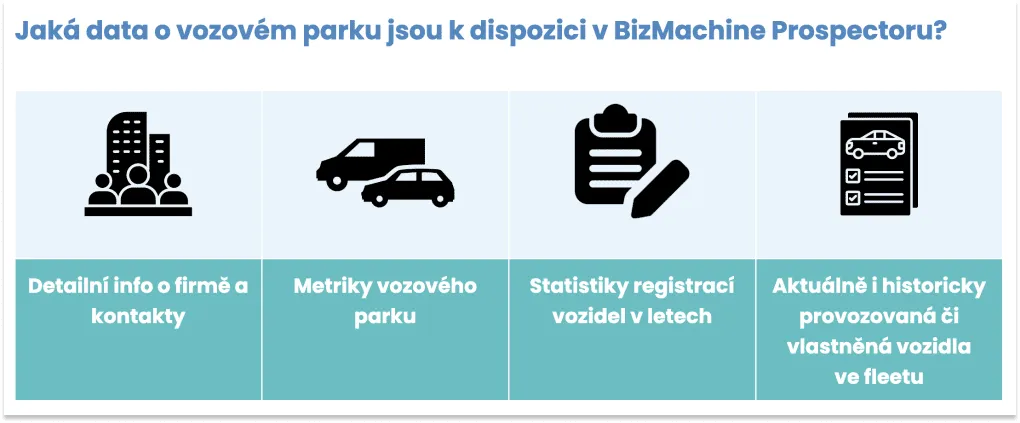
Some of the perspectives on your customers mentioned above are things no one else can offer. BizMachine tracks the truly current state of vehicle fleets — not just the first registration, which the company may have long since sold. With BizMachine data, you can find out which companies buy used vehicles and how old they are. For building lead lists for used car dealers, this data is essential. And similarly, BizMachine data lets you look at the full history of a company’s fleet. Are they shrinking their fleet? Growing it? Keeping it constant? This information helps you not only create relevant offers but also prioritize your time on customers where the data shows greater potential for your services.
“With our data, you see exactly who currently operates your brand — right now, not in the past. You see the age of their fleet, so you can invite them to the showroom in time and offer them spare parts at a reasonable price for all vehicles over a certain mileage. Because with us, you’ll know exactly how many they have in their fleet and how long they’ll keep them. Our data lets you learn from a client’s purchase history and reach out with the right offer at the right time. Does a company buy 10 used vehicles every year? They’ll probably buy them this year too. These precise data views of your customers and prospects wouldn’t be possible with first-registration data alone. That data can’t tell you whether a company has already sold or stopped operating a particular vehicle,” notes Martin Střecha.
All this data is available in BizMachine’s online tool, Prospector. Anyone who’s ever used an online search can operate it. All data is accessible in one or two clicks. BizMachine’s sales consultants and data analysts also save the most common filtering and segmentation approaches into regularly updated opportunity lists. With one click, you can find a pre-built selection of companies that, for example, have a certain volume of passenger or commercial vehicles older than 4 years. When you create your own list, you can easily save it or download it to your computer. No special skills needed — all the data is right at your fingertips!
“I’d also add that our strength lies in our team — the sales consultants who focus on the automotive segment at BizMachine. We work with nearly two hundred entities in this market. We can advise and help integrate data into the sales process. We advocate for individual salespeople to receive pre-selected customer groups for outreach from their marketing teams or sales management. I’d say we remove barriers and, thanks to data, help car and service dealers succeed with customers in less time and with better results,” concludes Martin Střecha.

Anna Evans
Anna Evans is the Head of Marketing at BizMachine, leading marketing strategy and execution across the Czech and Central European markets. She specializes in B2B positioning, sales enablement, and data-driven marketing. At BizMachine, she bridges the gap between data, technology, and go-to-market strategy to help sales and marketing teams find and win the right customers.


Pernerova 697/35
186 00 Praha 8
Czech Republic

+420 735 121 860
